This content is for informational purposes only and is not medical advice. Collagenium is published by a research-driven editorial team, not licensed medical professionals. See our editorial standards and methodology. Consult a registered dietitian, physician, or pharmacist before starting any supplement, especially if you have existing health conditions, are pregnant or breastfeeding, or take medications.
Collagen is the most abundant protein in your body, making up about 30% of your total protein. It is the structural material that gives skin its firmness, bones their flexibility, and tendons their strength. Think of it as the scaffolding, or glue, that holds your body together.
That is the short answer. Below are 9 facts that explain what collagen is, what it does, why you lose it as you age, and what actually helps you keep more of it. This is our hub page for the topic. Each fact links out to a deeper guide if you want to go further.
Our approach is research-based. Everything here is drawn from peer-reviewed studies, published reviews, and established biochemistry, with every claim cited. We are an editorial and research team, not licensed medical professionals.
The 9 facts at a glance
- Collagen is your body’s most abundant protein, about 30% of all protein.
- The name literally means “glue.”
- There are at least 28 types, but 5 do most of the work.
- Type I alone accounts for around 90% of your collagen.
- Your body builds it from amino acids plus vitamin C.
- You start losing collagen in your mid-20s.
- Sun, sugar, and smoking speed up the loss.
- Collagen does far more than skin: bones, joints, gut, and muscle rely on it.
- You cannot rub it or eat it straight into your skin, but you can support production.
Fact 1: Collagen is the most abundant protein in your body
Collagen makes up roughly 30% of the total protein in the human body and about 70 to 80% of the dry weight of your skin. It is found in your skin, bones, muscles, tendons, ligaments, cartilage, blood vessels, and even the lining of your gut.
No other single protein is as widespread. If you stripped away collagen, tissues would lose their shape and strength almost immediately. It is the reason skin holds together, joints glide, and bones bend slightly under load instead of snapping.
Fact 2: The name literally means “glue”
The word collagen comes from the Greek “kolla,” meaning glue, and the suffix “-gen,” meaning producing. Early manufacturers actually boiled animal hides and bones to make glue, and the protein that made it sticky was collagen.
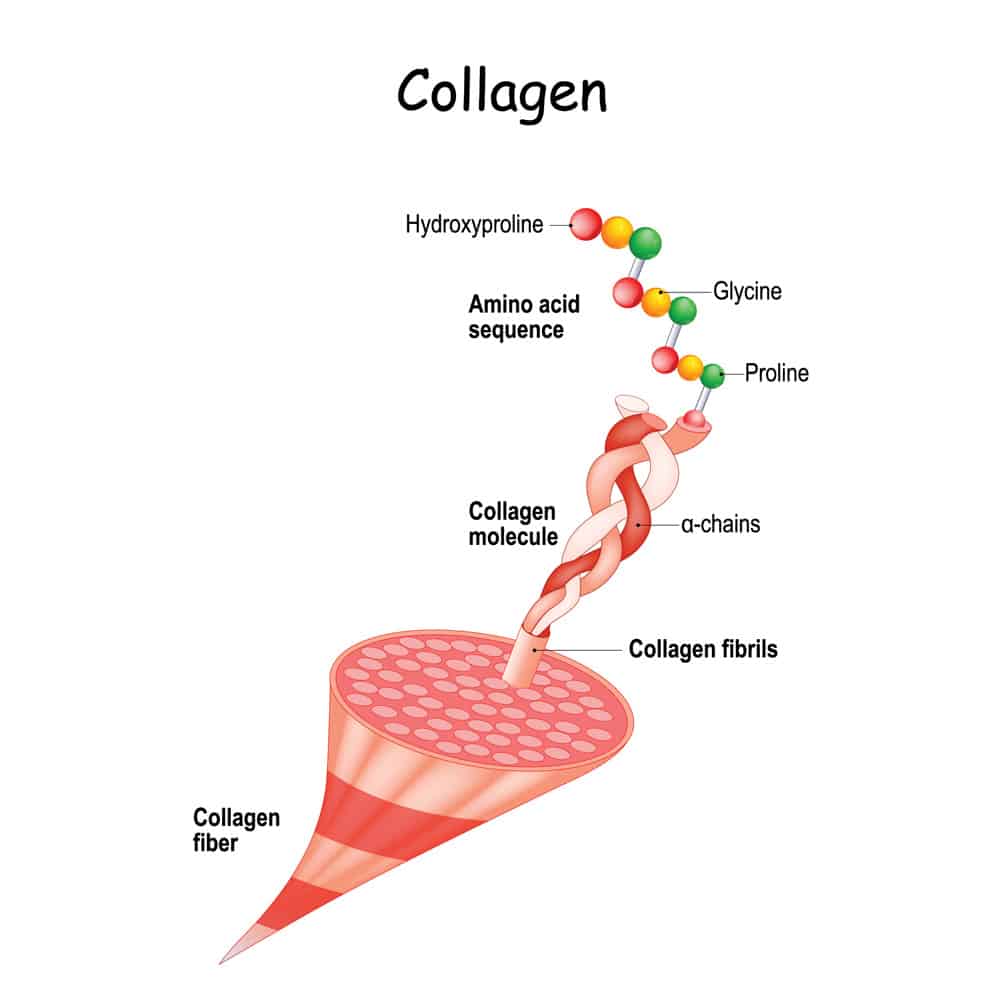
The name is a fair description of the job. Collagen molecules twist together into strong, rope-like fibers that bind cells and tissues into organized structures. It provides tensile strength, the ability to resist being pulled apart, which is exactly what skin, tendons, and ligaments need.
Fact 3: There are 28 types, but 5 do most of the work
Scientists have identified at least 28 different types of collagen. For everyday purposes, five matter most:
| Type | Main locations | Best known for |
|---|---|---|
| Type I | Skin, bone, tendon, teeth | Skin firmness, structure |
| Type II | Cartilage | Joint cushioning |
| Type III | Skin, muscle, blood vessels | Works alongside Type I |
| Type V | Hair, placenta, cell surfaces | Regulates fiber formation |
| Type X | Growth-plate cartilage | Bone development |
If you have compared supplement labels, this is why some are marketed as “Type I and III” (skin focus) and others as “Type II” (joint focus). We break the differences down in our guides on collagen type 1 vs type 3 and type 1 vs type 2.
Fact 4: Type I is about 90% of your collagen
Of all the types, Type I dominates. It accounts for roughly 90% of the collagen in your body and is the main form in skin, bone, and tendon.
This is why most skin-focused supplements center on Type I, sourced from either cattle (bovine collagen) or fish (marine collagen). Type II, from chicken cartilage, is the one usually chosen for joint support instead. Multi-collagen blends combine several types in one product, covered in our multi-collagen guide.
Fact 5: Your body builds collagen from amino acids plus vitamin C
Your body makes its own collagen constantly. To do it, cells called fibroblasts string together amino acids, especially glycine, proline, and hydroxyproline, into long chains that fold into the triple-helix collagen structure.
Vitamin C is not optional here. It is a required cofactor for the enzymes that stabilize the collagen helix, which is why severe vitamin C deficiency (scurvy) causes collagen to fall apart, leading to bleeding gums and poor wound healing. Zinc and copper play supporting roles too.
The practical takeaway: collagen production depends on getting enough protein and enough vitamin C. You can read more about the foods that supply both in our guide to collagen-rich foods.
Fact 6: You start losing collagen in your mid-20s
Collagen production is not constant for life. It peaks in early adulthood, then slowly declines. A study of chronologically aged skin found that collagen production drops measurably as people get older, and other research estimates skin collagen falls by roughly 1% per year after age 20.
For women, the decline steepens around menopause. Estrogen supports collagen synthesis, so the first years after menopause can bring a faster drop. This gradual loss is a major reason skin loses firmness and fine lines appear over time. We cover the visible side of this in collagen for loose skin.
Fact 7: Sun, sugar, and smoking speed up the loss
Aging is not the only driver. Several lifestyle and environmental factors break down existing collagen or slow new production:
- UV exposure: Sunlight triggers enzymes that degrade collagen in the dermis. Photoaging (sun damage) is one of the biggest causes of wrinkles.
- Excess sugar: High blood sugar drives glycation, a process where sugar molecules bond to collagen fibers and stiffen them, making skin less elastic. We explain this in collagen cross-linking.
- Smoking: Tobacco smoke reduces collagen production and constricts blood vessels that feed the skin.
The good news is that these are largely within your control. Daily sun protection in particular does more to preserve collagen than most supplements.
Fact 8: Collagen does far more than skin
Skin gets the marketing attention, but collagen is a full-body structural protein. It gives bones their flexible framework, forms the cartilage that cushions joints, builds the tendons and ligaments that connect muscle to bone, reinforces blood vessel walls, and helps hold the gut lining together.
That is why collagen research reaches beyond cosmetics. Collagen hydrolysate has been studied for osteoarthritis and joint comfort, for example, not just wrinkles. For the full breakdown of collagen’s roles in the body, see our sibling guide, 7 things collagen does for your body.
Fact 9: You cannot eat or rub collagen straight into your skin
This is the fact most marketing gets wrong. When you eat collagen, whether from bone broth or a supplement, your digestive system breaks it into amino acids and small peptides. Those are absorbed and distributed wherever your body needs them, not deposited intact as skin collagen. Topical collagen creams face the opposite problem: the molecule is generally too large to pass through the skin barrier.
So does supplementing help at all? The evidence is cautiously positive. A systematic review of dermatological studies found oral collagen peptides showed promise for skin hydration and elasticity, and a controlled trial reported improved skin moisture after supplementation. The likely mechanism is that the peptides act as building blocks and may signal fibroblasts to produce more collagen. Results are modest and take 8 to 12 weeks of consistent use, not overnight.
If you want to try it, our guides on what collagen actually does, whether collagen is good for you, and our roundup of the best collagen supplements are the logical next steps.
How to support your collagen: the practical version
You cannot stop aging, but you can tilt the balance toward keeping more collagen:
- Feed production. Eat enough protein and vitamin C. Add zinc and copper from a varied diet. See collagen-rich foods.
- Protect what you have. Wear sunscreen daily, do not smoke, and limit excess sugar to slow glycation.
- Consider supplementing. Hydrolyzed collagen peptides are the most-studied form. Learn when to take collagen and set a realistic results timeline.
- Be patient and consistent. Every study showing benefit ran for weeks to months of daily use.
Explore the full collagen library
This page is the starting point. From here, follow the thread that matches your goal:
- What does collagen do? 7 functions in the body
- Is collagen good for you? The evidence
- Collagen benefits, explained
- Collagen for skin and collagen for joint health
- Collagen-rich foods and bone broth
- Collagen peptides guide and hydrolyzed collagen guide
- Best collagen supplements, for women, and for men
The bottom line
Collagen is the structural protein your body relies on most: about 30% of your total protein and the framework of skin, bone, and connective tissue. You make it from amino acids and vitamin C, you start losing it in your mid-20s, and sun, sugar, and smoking speed the loss. You cannot deposit collagen directly into your skin, but you can feed production and protect what you have. Start with food and sun protection, then decide whether a collagen supplement fits your goals.
Frequently asked questions
What is collagen in simple terms?
Collagen is a structural protein that acts like glue, holding your body together. It gives skin its firmness, bones their flexibility, and tendons and ligaments their strength. It is the most abundant protein in the body, roughly 30% of your total protein.
What does collagen do for your body?
Collagen provides structure and strength to skin, bones, cartilage, tendons, ligaments, blood vessels, and the gut lining. It helps skin stay firm and hydrated and helps connective tissue resist stretching and tearing. See our guide on the 7 things collagen does.
At what age does collagen start to decline?
Collagen production begins a slow decline in your mid-20s. Research estimates skin collagen decreases by roughly 1% per year after age 20, and the drop accelerates for women in the first years after menopause.
Can you increase collagen naturally?
You cannot eat collagen and send it straight to your skin, but you can support production. Adequate protein, vitamin C, zinc, and copper supply the raw materials, while sun protection, not smoking, and limiting excess sugar protect the collagen you already have.
Is the collagen in supplements the same as body collagen?
Supplement collagen comes from animal sources (cattle, fish, chicken) and is usually hydrolyzed into peptides. Your body breaks these down into amino acids and peptides during digestion, then uses them as building blocks. It is not deposited directly as skin collagen.
Sources
Every health claim in this article is traceable to a primary source. See our editorial standards.
- 1.
- 2.
- 3.
- 4.
- 5.

Collagenium
Research-driven editorial teamEditorial & Research Team
Collagenium synthesizes peer-reviewed studies on collagen, skin health, and connective-tissue science into reader-friendly guides. We cite every claim and are not licensed medical professionals. See /methodology/ for our editorial standards.